

Groups like the Financial Accounting Standards Board (FASB) and the American Institute of Certified Public Accountants (AICPA) offer guidance. They teach us that assets and expenses should have a Debit balance. Meanwhile, liabilities, equity, and revenues should be Credit.

Application of the rules of debit and credit
- For example net sales is gross sales minus the sales returns, the sales allowances, and the sales discounts.
- Since your company did not yet pay its employees, the Cash account is not credited, instead, the credit is recorded in the liability account Wages Payable.
- We want to make sure we are accurately accounting for what we have (asset) and what we used (expense).
- Hopefully this will give you a deeper understanding of the terms debit and credit which are central to the 500-year-old, double-entry accounting and bookkeeping system.
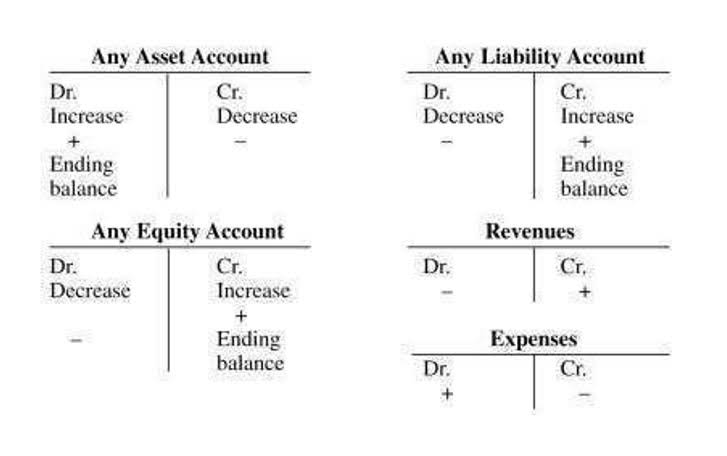
- Asset accounts normally have debit balances, while liabilities and capital normally have credit balances.
T-accounts are logs of individual transactions that show how each entry affects assets, liabilities, or equity. Balance sheets skip this process and present the end result—what the company owns, owes, and retains. A ledger account (also known as T-account) consists of two sides – a left hand side and a right hand side. The left hand side is commonly referred to as debit side and the right hand side is commonly referred to as credit side.
Journal Entry 1

Understanding this is important for showing their value on the balance sheet. In general, debits are used to increase asset and expense accounts, while credits are used to increase liability and equity accounts. Contra-equity Accounts are equity accounts with a normal debit balance, instead of the credit balances that equity accounts normally have. Two examples of contra-equity accounts are the Owner’s Drawing account and Treasury Share account.
- For example, let’s assume that your company buys and sells hardware storage devices such as memory cards and hard drives.
- When you’re done, scroll down just below and compare your answers.
- The permanent accounts are sometimes described as real accounts.
- There are also transaction that hit your balance sheet (assets and liabilities) that do affect your cash flow but not your income statement.
- Insurance Expense, Wages Expense, Advertising Expense, Interest Expense are expenses matched with the period of time in the heading of the income statement.
- The net realizable value of the accounts receivable is the accounts receivable minus the allowance for doubtful accounts.
( . Liability accounts:
In the Cash T-Account, the $8,300 payment of cash goes on the right (credit) side of the account because Cash is decreasing. In the Fees Earned T-Account, the $18,300 revenue goes on the right (credit) side of the account because the revenue is increasing. In the Accounts Payable T-Account, the $3,300 deposit goes on the right (credit) side of the account because the https://bluetaillizard.com/2022/11/10/what-is-a-plant-asset-in-accounting-definition-and/ liability is increasing. In the Joe Smith, Capital T-Account, the $55,000 deposit goes on the right (credit) side of the account because equity is increasing. Opened a business bank account with a deposit of $55,000 from personal funds.
- This double-entry system provides accuracy in the accounting records and financial statements.
- It is recommended to keep any unused accounts for at least until the end of a 12-month accounting period before deleting them.
- In small business bookkeeping, it’s important to learn to think your way through a transaction.
- I say normal balances because they don’t always have balances on those sides—but they should.
- A glance at an accounting chart can give you a snapshot of a company’s financial health.
- Learn what T-accounts are in accounting with clear T-account examples, key benefits, and a simple guide to transaction recording.
T-Account Debits and Credits
Customers’ bank accounts are reported as liabilities and Travel Agency Accounting include the balances in its customers’ checking and savings accounts as well as certificates of deposit. In effect, your bank statement is just one of thousands of subsidiary records that account for millions of dollars that a bank owes to its depositors. Ledger accounts use the T-account format to display the balances in each account.
Income Statement Accounts are Temporary Accounts
An accounts payable T-account tracks what a company owes. Credits on the right increase the liability (invoices received), and debits on the left decrease it (payments made). T-accounts help keep the books balanced by showing all payables and payments clearly. Journal entries are the official, chronological records of all financial transactions. Each entry lists the accounts affected, the corresponding debit and credit amounts, and the transaction date.
T-account vs. ledger
Let’s assume, as a second example, that your business maintains a checking account with a bank that is used for depositing sales and issuing checks for payments. All transactions related to this checking account will be recorded in a t account normal balance ledger account called Cash in Bank. This account will show all checking account deposits as increases to the Cash in Bank account and all cash withdrawals or check payments as decreases. The income statement accounts are temporary because their balances are not carried forward to the next accounting year.